Top 5 AI Trends to Watch in 2026: Shaping Enterprise Growth
AI is unstoppable. The Top 5 AI Trends to Watch in 2026 highlight how AI is shifting from tools to enterprise-wide systems. This guide explains agentic AI, multimodal models, domain-specific AI, governance, and smarter infrastructure, helping leaders prepare for scalable, ROI-driven AI adoption.

2026 will be a pivotal year where AI transitions from a tool into a strategic, collaborative partner. After years of breathtaking technical advances, the focus is shifting toward making AI's immense potential tangible and useful. The core question is no longer just "What can AI do?" but "What valuable outcomes can it help us achieve?". As we move from initial excitement to concrete evaluation, here are the top 5 AI trends to watch in 2026.
AI Adoption Trends and Future Forecasts
Enterprise AI adoption has reached unprecedented levels in 2025. In fact, nearly nine in ten companies now report using AI in at least one business function. The most successful companies are shifting from using AI for isolated tasks to embedding it into entire workflows. This practice is known as enterprise-wide AI. However, research indicates that only 2% of organizations were fully prepared for this level of integration at the start of 2025. It highlights a significant execution gap between ambition and operational reality.
The global artificial intelligence market is projected to reach US$347.05 billion in 2026. The Generative AI market specifically is expected to reach US$91.57 billion in 2026 with a CAGR of 7.00% from 2026 to 2031. Gartner provides the most detailed forecast. It predicts total spending to reach $2.52 trillion in 2026, a 44% year-over-year increase. The International Monetary Fund (IMF) states that the AI investment boom is a key factor in steadying global growth. It has the potential to lift global GDP growth by up to 0.3 percentage points in 2026. Specifically for the U.S., the IMF upgraded its 2026 growth forecast to 2.4%.
As we look toward 2026, several key trends emerge. Each corresponds to a priority or pain point for enterprises. Below, we outline the major AI adoption trends in the enterprises.
Top AI Trends to Watch in 2026
As AI matures, its trajectory is being shaped by real enterprise demands—scalability, reliability, governance, and measurable returns. The top AI trends in 2026 are less about experimentation and more about execution at scale. They reflect how organizations are embedding AI deeper into their:
- Operations
- Decision-making
- And customer engagement.
Plus, they address the limitations uncovered during earlier adoption phases.
Below are the most important AI trends that will define enterprise strategy, technology investment, and competitive differentiation in 2026. Let’s start without wasting time.
1. Agentic AI: The Rise of Autonomous AI Agents
Agentic AI represents a major shift in how artificial intelligence is deployed inside enterprises. Instead of functioning as passive assistants, agentic systems are designed to operate with autonomy. They can plan tasks, make decisions, and execute workflows independently. As organizations prepare for 2026, these AI agents are increasingly positioned as digital operators embedded directly into business processes. Moreover, these enable faster execution, reduce manual effort, and optimize operations across functions.
Do you want to create your AI Agent? Here is a complete guide to build an AI agent.
Working Strategy
Agentic AI systems typically operate through a structured execution loop:
- Goal Definition: A business objective is assigned to the agent, such as resolving a customer issue or completing a financial task.
- Task Decomposition: The agent breaks the objective into smaller, manageable steps.
- Tool Selection: It identifies and connects to relevant tools, APIs, databases, or applications.
- Action Execution: The agent performs actions across systems in sequence or parallel.
- Evaluation and Adjustment: Outcomes are assessed, errors corrected, and next steps refined.
- Escalation or Completion: The task is either completed autonomously or escalated to humans when predefined thresholds are met.
This loop allows agents to operate continuously with minimal supervision.
Significance and Market Potential
Agentic AI acts as a foundational capability for enterprises moving into 2026. The market outlook for agentic AI reflects its growing strategic importance. According to Gartner, by 2028 about 33 percent of enterprise software applications will include agentic AI capabilities, up from less than 1 percent today. This signals a clear shift toward AI systems that deliver sustained operational value rather than incremental productivity gains.
2. Multimodal AI: One Model, Multiple Inputs
Multimodal AI is rapidly becoming a core enterprise capability as organizations move beyond text-only systems. These models can understand and process text, images, audio, video, and structured data together. In real business environments, information rarely exists in a single format. By 2026, enterprises will increasingly rely on multimodal AI. It will handle complex, real-world workflows such as document analysis, customer interactions, medical imaging, and enterprise search.
Working Strategy
Multimodal AI systems operate by unifying multiple data types into a single reasoning process:
- Input Ingestion: Text, images, audio, video, and data files are ingested simultaneously.
- Cross-Modal Understanding: The model aligns and interprets relationships across formats.
- Context Fusion: Insights from different inputs are combined into a shared context.
- Unified Reasoning: The system generates outputs based on the full, multi-format view.
- Action or Response: Results are delivered as text, visuals, decisions, or automated actions.
It enables richer understanding and more accurate outputs than single-mode AI.
Significance and Market Potential
Multimodal AI is critical for scaling AI into real business operations. Gartner identifies multimodal AI as a key driver of enterprise AI adoption. It significantly improves accuracy, usability, and decision quality across use cases. As customer experience, automation, and analytics increasingly depend on diverse data sources, multimodal AI will become a default requirement rather than an advanced feature by 2026.
3. Domain-Specific Models: Replacing Generic AI Systems
Generic AI models are increasingly proving insufficient for enterprise needs. In response, organizations are turning to domain-specific AI models trained on industry-relevant data. These models deliver higher accuracy, better compliance, and more reliable outputs. By 2026, domain-specific AI will replace generalized systems. It will happen across regulated and complex industries such as healthcare, finance, legal services, manufacturing, and logistics.
Working Strategy
Domain-specific AI models are built through targeted design and training:
- Collect Domain Data: Teams curate and validate industry-specific datasets relevant to the use case.
- Train Specialized Models: Engineers train or fine-tune models using domain-focused data and objectives.
- Embed Rules and Context: Developers incorporate industry rules, terminology, and operational constraints directly into the model.
- Validate Performance: Organizations test outputs against domain benchmarks and real-world scenarios.
- **Deploy with Controls:**Teams deploy models with stricter guardrails, monitoring, and human oversight.
This approach ensures relevance, reliability, and regulatory alignment.
Significance and Market Potential
Specialized generative AI tools deliver greater time savings and higher quality outputs than general-purpose tools. Gartner predicts that domain-specific AI models will dominate enterprise use. Moreover, 50% of enterprise generative AI models will become domain-specific by 2028. Domain-specific AI models provide greater accuracy and business relevance compared to general models. These helps address challenges like data integrity and model trust in scaling generative AI programs. Domain-specific models offer precision and reliability in focused tasks like those for detecting sustainable development goals.
4. Enterprise AI Governance: From Policy to Practice
Governance refers to principles, policies, and practices. These help aligning AI with ethical values, mitigating risks like bias through data governance and transparency. Its principles include:
- Accountability via leadership mandates
- Explainability for human-AI collaboration
- Provenance for data origins.
In 2026, enterprise AI governance has shifted from optional best practices to a core business requirement. AI becomes deeply integrated into everyday workflows, decision-making, and operations. Now companies are moving beyond basic policies to build structured, operational frameworks. These focus on managing risks like bias, data leaks, and compliance with tightening regulations. Plus, these will ensure accountability, transparency, and ethical use. High-performing organizations now treat governance as essential for scaling AI safely, achieving real ROI, and building trust.
Working Strategy
Enterprise AI governance operates through formalized controls:
- Policy Definition: Clear rules for AI usage, data access, and decision authority.
- Model Oversight: Continuous monitoring of model behavior and performance.
- Risk Management: Identification and mitigation of bias, security, and compliance risks.
- Auditability: Logging and traceability of AI decisions and actions.
- Human Accountability: Defined escalation paths and ownership structures.
These mechanisms ensure AI systems remain aligned with business and regulatory expectations.
Significance and Market Potential
AI governance is a framework bridging strategies, policies, and ethics to ensure scalable, trusted AI. It drives competitiveness and stakeholder confidence in an AI economy. Its framework comprises of three pillars—responsible, ethical, trustworthy AI—with centralized oversight. Dynamic AI governance integrates policies, checklists, and tools, adapting to AI evolutions for trustworthy systems that are safe and transparent. It addresses rapid AI changes (e.g., gen AI adoption), builds public trust, and mitigates biases/errors.
AI governance frameworks regulate AI development and use to ensure ethical standards and minimize harm. According to PwC report, it reduces burden as portfolios expand, saving 20-50% time for scalability.
5. Smarter AI Infrastructure: Efficiency Becomes Strategic
Infrastructure optimization has indeed emerged as a central pillar of enterprise AI strategy. The rapid expansion of AI workloads is putting pressure on enterprise infrastructure. Deloitte's Tech Trends 2026 explicitly calls this "The AI infrastructure reckoning," emphasizing the need to optimize compute strategy. Enterprises are recalculating infrastructure due to:
- Massive inference costs
- Hybrid cloud/on-premises decisions
- And the realization that existing setups are misaligned with AI demands.
As a result, AI infrastructure is evolving to become smarter, more adaptive, and more cost-efficient. By 2026, infrastructure optimization will be a central pillar of enterprise AI strategy.
Working Strategy
Smarter AI infrastructure focuses on intelligent resource management:
- Workload Optimization: Dynamic allocation of compute based on task priority.
- Model Right-Sizing: Deploying models appropriate to performance needs.
- Hardware Acceleration: Use of AI-optimized chips and architectures.
- Energy Efficiency Controls: Monitoring and reducing power consumption.
- Cost Governance: Tracking and optimizing AI spend across teams and projects.
This ensures AI remains scalable and economically viable.
Significance and Market Potential
Gartner forecasts highlight explosive growth in AI infrastructure. The spending (e.g., AI-optimized servers and IaaS surging will reach ~$2.5 trillion in 2026. The global AI infrastructure market is valued at approximately USD 135-158 billion in 2025-2026 and is projected to reach USD 223-418 billion by 2030, with CAGRs ranging from 14.89% to 30.4%. This growth is fueled by demand for high-performance computing, generative AI, and LLMs. AI accelerator chips alone (a core component of smarter infrastructure) are expected to exceed USD 600 billion by 2033, growing at 16% CAGR from USD 116 billion in 2024, with Nvidia holding 70-75% share through 2030.
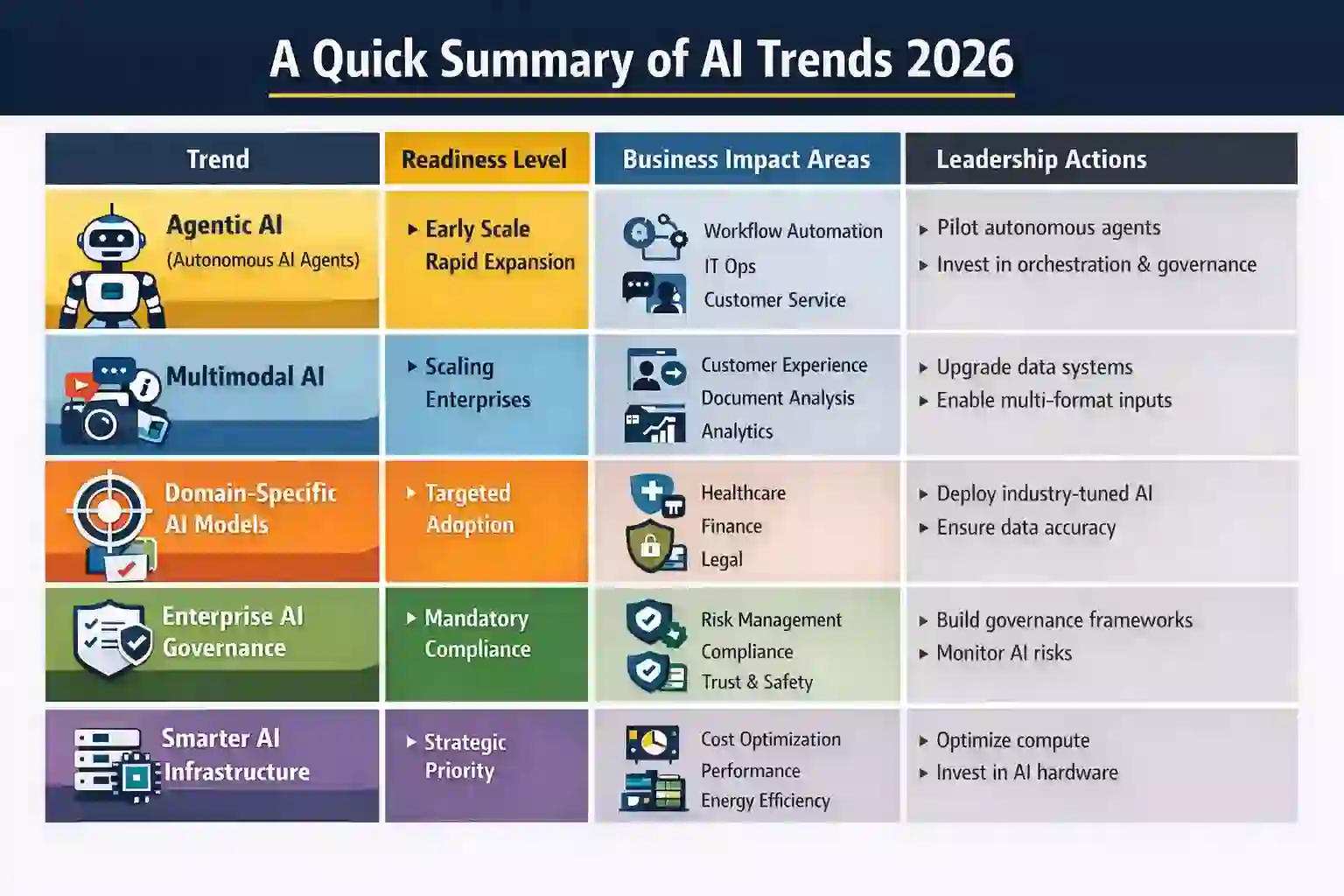
Here is a quick summary to the top 5 AI trends to watch in 2026.
Conclusion
As we move toward 2026, AI is no longer an experimental technology. It has become a core part of enterprise strategy. The top 5 AI trends outlined in this article show a clear shift from isolated use cases to AI embedded across workflows. Agentic AI, multimodal systems, and domain-specific models are driving real operational impact. At the same time, governance and infrastructure are becoming critical enablers, not afterthoughts. The focus is now on scale, reliability, and measurable ROI. Enterprises that invest early and execute well will gain a lasting competitive advantage. In 2026 and beyond, success with AI will depend on execution, not experimentation.